Water Cooler Guide: How to Choose, Set Up, and Care for One

A water cooler is an electric appliance that dispenses cold, hot, or room-temperature drinking water. Bottled models use 3- to 5-gallon jugs, while bottleless models connect to your water line. Space, plumbing, and daily use decide which fits your home or workplace best. This water cooler guide works as a simple buying guide for anyone choosing an office water cooler or a water cooler for home use. It also covers setup, costs, safety, and basic care.
What Is a Water Cooler?
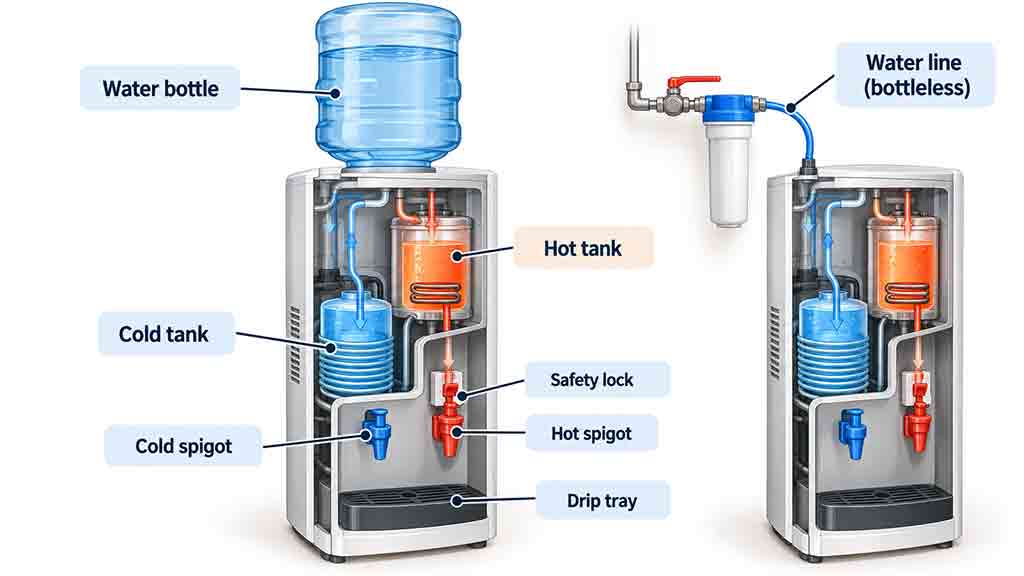
A water cooler is a plug-in appliance that gives you chilled, hot, or room-temperature drinking water whenever you want it. It holds water in an internal tank, cools or heats it, and sends it out through a spigot. Most coolers take water from a bottle, and some connect to the building’s water line instead.
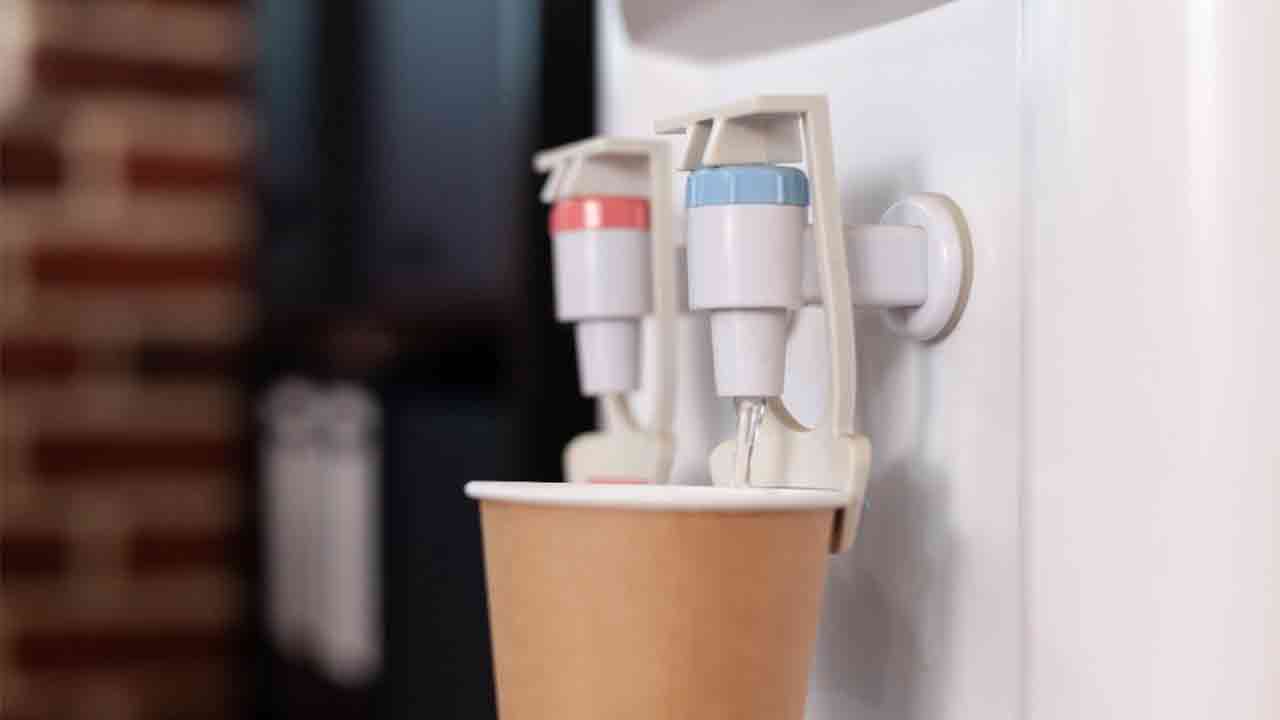
Most home and workplace water cooling systems have the same basic parts:
- A place for the water source
- A cold tank
- A hot tank on some models
- One or two spigots
- A drip tray
- A safety lock on units that make hot water
Water Cooler vs Water Dispenser
The two terms often mean the same thing. Some stores use “water cooler” for units that chill or heat water and “water dispenser” for units that only give room-temperature water. If a product page uses both words, check the listed temperature options to see what the unit really does.
How Does a Water Cooler Work?
A water cooler works by moving water from a bottle or a water line into a small tank, then cooling or heating it until you press a spigot. The water source feeds the tanks, and the spigots give you the temperature you pick.
The cold tank uses a small cooling system, much like a mini refrigerator, to keep water chilled. The hot tank uses a heating element. Many models keep both tanks full and ready, so they reheat and re-chill water every few hours, even when no one is drinking. Some on-demand units heat water only when you ask for it, which saves energy but can mean a short wait for hot water.
The drip tray catches spills. It is not a drain, so it needs to be emptied. On models with a safety lock, you press a button or lever before hot water flows, which can lower the chance of accidental burns but does not replace adult supervision.
Types of Water Coolers
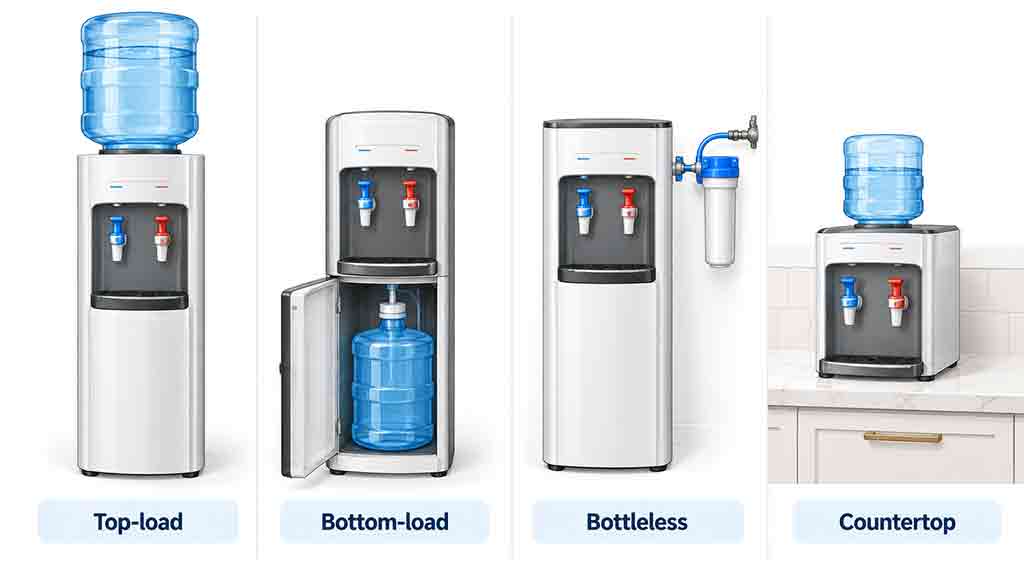
Water cooler guides typically mention the main types based on: how the water gets in (a bottle or a water line), where the unit sits (floor or counter), and which temperatures it offers.
Bottled Coolers: Top-Load and Bottom-Load
Bottled coolers run on delivered jugs. On a top-load model, you flip the jug upside down onto the top, and gravity moves the water down. On a bottom-load model, the jug sits in a cabinet at the base, and a small pump pulls the water up.
Lifting is the biggest difference between the two. A full 5-gallon jug weighs about 40 pounds, since water weighs roughly 8.3 pounds per gallon. Top-load units usually cost less, while bottom-load units can reduce the strain of lifting. If heavy lifting is a concern, 3-gallon bottles are easier to carry, though you will swap them more often.
Bottleless (Point-of-Use) Coolers
A bottleless cooler, also called a point-of-use or plumbed-in cooler, connects straight to the building’s water line. Many have a filter built in, so there are no jugs to order, lift, or store. The catch is the setup. These units often need a plumber and a spot near a water line and a drain.
Floor-Standing vs. Countertop Coolers
Floor-standing coolers hold larger bottles and suit more people. Countertop coolers save floor space and usually hold smaller bottles. Some countertop units may not chill water as well as floor models. Both styles come in bottled and bottleless versions.
Hot and Cold, Cold Only, or Room Temperature
Hot and cold models use two tanks, so both temperatures are ready at once. They are handy for tea, coffee, and instant meals. Cold-only models are simpler and use less energy. Room-temperature models usually use the least energy. If you choose a model with hot water and children or visitors use it, pick one with a safety lock.
Bottled vs Bottleless Water Coolers: Which Is Better for You?
Neither type is better for everyone. The right choice depends on your space, your plumbing, and how much water people drink each day.
| Factor | Bottled cooler | Bottleless (point-of-use) cooler |
| Water source | 3- to 5-gallon bottles that are delivered or exchanged | The building water line, usually with a filter in the unit |
| Setup | Plug it in and load a bottle; no plumbing | Water line connection, often a drain, and often a plumber |
| Lifting | A full 5-gallon bottle weighs about 40 pounds; bottom-load models avoid lifting it overhead | None |
| Ongoing tasks | Order and swap bottles, store spares, clean at bottle changes | Filter changes and cleaning set by the manual |
| Running out | Possible if a delivery is missed | Not tied to deliveries |
| Water quality | Set by the bottled water you choose (spring, purified, or distilled) | Set by the incoming water and the filter’s certification |
| Space | Floor space for the cooler and spare bottles | The cooler only |
| Moving it | Easy, as long as an outlet is nearby | Limited by the water line and drain |
| Best for | Homes, small and mid-size workplaces, and spaces with no water line nearby | Busy offices and shared kitchens that have a water line and drain close by |
The FDA regulates bottled water, and contamination can still happen during storage or after purchase (CDC), but it can still pick up contamination during storage or after purchase. Clean storage matters.
Choose a bottled cooler if:
- No water line is nearby.
- You want an easy setup.
- You need to move the cooler occasionally.
- Compare delivery with buying cases at the store before deciding.
Choose a bottleless cooler if:
- A water line and drain are nearby.
- Many people share the cooler.
- Lifting heavy bottles is difficult.
How to Choose the Right Water Cooler
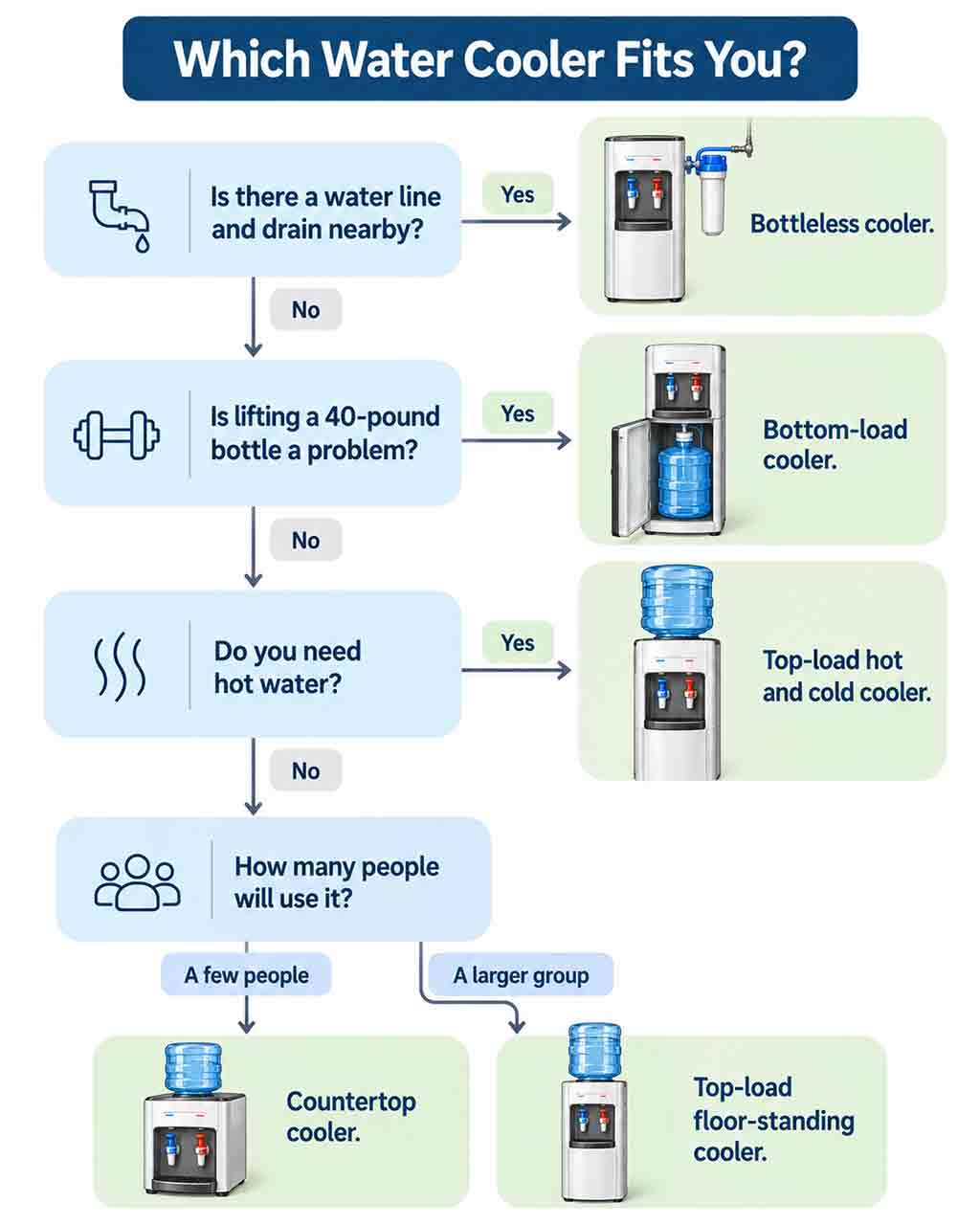
The right water cooler depends on how many people use it, how much space and plumbing you have, whether you need hot water, and what you want to spend. The steps below give you a simple water cooler buying guide:
People and Daily Use
Choosing the right cooler size starts with the number of people:
- A small team of 1 to 10 people often does well with a countertop or compact floor cooler.
- A standard floor cooler suits about 11 to 25 people.
- For 26 to 50 people, a plumbed-in unit or more than one floor cooler works better, and for more than 50 people, most offices need several plumbed-in units.
Daily use matters too:
- Light drinkers often use about 1 liter a day, average drinkers use 1 to 2 liters, and heavy drinkers often use more than 2.
- Heavy use points to a larger or bottleless unit.
Space, Power, and Plumbing
Measure the spot before you shop. You need floor or counter space, an outlet within reach, and a little room around the unit so air can flow. A bottleless cooler also needs a water line and a drain nearby. If you cannot get both, choose a bottled cooler.
Hot Water and Extra Features
Decide first if you need hot water. If you do, pick a model with a safety lock, especially around children and visitors. A slide-out drip tray is easier to empty, and a stainless steel finish wipes clean quickly. Touch-free dispensing is a useful extra when many people share the cooler.
Filtration
Filters do different jobs, so match the filter to the problem you want to solve. Activated carbon reduces chemicals such as chlorine, which improves taste and smell. Reverse osmosis removes minerals but works less well on chemicals.
Look for NSF/ANSI certification. Standard 42 covers taste and smell, Standard 53 covers contaminants with health effects, and Standard 58 covers reverse osmosis. Certification to one standard does not mean a filter reduces everything, so check the exact model in the certified product listings (NSF). Filters wear out, so ask how often they need replacing and what a new one costs.
Energy Use
A cooler runs all day, so check its energy use before you buy. ENERGY STAR certified models use about 22% less energy than standard ones. The daily limits are 0.16 kWh for cold-only units, 0.18 kWh for hot and cold on-demand units, and 0.68 to 0.80 kWh for hot and cold storage units. To estimate yearly cost, multiply the daily kWh by 365, then by your electric rate. At 0.68 kWh a day, that is about 248 kWh a year.
Rent or Buy
Renting spreads the cost into a monthly fee, and that fee often covers maintenance and basic troubleshooting. Buying costs more upfront and leaves repairs and cleaning to you. Buy if you plan to keep the unit for many years and can maintain it yourself. Rent if you want service included or may want to switch models later.
Questions to Ask a Water Cooler Provider
Before you sign anything, ask about:
- Whether maintenance is included, and how often it happens
- Who cleans the unit
- The deposit and delivery terms
- Whether you can pause or change your delivery schedule
- What happens if the cooler breaks
- Whether you can switch to another cooler type later
- The cancellation terms
Which Cooler Fits Which Space?
The best fit depends on who uses the cooler and where it sits. An office water cooler faces different demands than a water cooler for home use, and a shop, gym, or clinic has its own needs. Use this water cooler guide to decide better:
| Space | What Matters Most | Often a Good Fit |
| Office break room | Daily use by many people, hot water for tea | Floor-standing bottled or bottleless unit |
| Clinic or waiting room | Visitors, cleanliness, safety | Countertop or floor unit with a safety lock and a cup supply |
| Gym or fitness studio | Heavy cold water use | Floor-standing or bottleless unit with strong cold output |
| Shop floor or warehouse | Heat and dust, no kitchen | Floor-standing bottled unit |
| Church or community hall | Occasional heavy use | Bottled unit with spare bottles on hand |
| Home kitchen | Family use, limited floor space | Countertop or bottom-load floor unit |
| Home office | One or two users | Countertop unit |
Water Cooler Costs and What to Expect
Prices vary by provider and model, so it helps to know what drives the total. These are the main factors that affect the price:
- The type of cooler, since a bottleless or hot and cold model usually costs more than a basic bottled one.
- Whether you rent or buy, because renting spreads the cost into a monthly fee and buying costs more at the start.
- The size and number of water bottles you use, and the refundable deposit on each 5-gallon bottle with the first delivery.
- How often water is delivered, whether weekly, every two weeks, or monthly, and any delivery fees or minimum orders.
- Setup or installation, which is more likely with a bottleless cooler that connects to your water line.
- Filter changes and cleaning, which a rental often covers through regular maintenance and basic troubleshooting.
- Electricity, which is higher for coolers that keep hot and cold water ready all day.
- The number of people using it, since more drinkers mean more water and more frequent deliveries.
How to Install and Set Up a Water Cooler
To install a water cooler, pick a good spot, follow the manufacturer’s manual, and then either load a bottle or connect the water line. A bottled model takes a few minutes. A bottleless model takes more planning.
Placing the Water Cooler
The spot you pick affects how well the cooler works and how easy it is to clean. Look for:
- A level floor or a sturdy counter
- An outlet within easy reach, so no cord crosses a walkway
- A place away from direct sunlight, ovens, and heaters
- The vent space listed in the manual, so air can flow around the unit
- For bottleless units, a short route to the water line and drain
- Enough room for people to line up without blocking a door or hallway
If the manual differs from this list, follow the manual.
Setting Up a Bottled Cooler
- Unpack the cooler, remove all packing material, and check for damage.
- Place it on a level surface with the space the manual asks for.
- Wash your hands and wipe the neck of the new bottle with a clean cloth.
- Load the bottle. Flip it into place on a top-load model, or attach the cap or tube on a bottom-load model.
- Press the spigot until water flows without air bursts.
- Plug the cooler in and let it chill for a few hours before you check the temperature.
- Check the bottle seat and the base for leaks.
Setting Up a Bottleless Cooler
- Confirm that you have a shutoff valve, a water line, a drain if the model needs one, and a grounded outlet.
- Turn off the water supply.
- Connect the water line to the unit with the fittings that came with it.
- Install the filter and flush it as the manual directs.
- Route the drain line, if the model has one, as the manual shows.
- Turn the water on slowly and check every connection for leaks.
- Plug the unit in, check the temperatures during the first day, and look at the connections again after 24 hours.
When to Call a Professional
Bottled setup is easy for most people, but bottleless setup can involve plumbing. Call a licensed plumber or your cooler provider if:
- The job needs new water line work.
- A drain is required, and none is nearby.
- There is no shutoff valve close to the spot.
- A leak remains after you tighten the connections.
- You are unsure about the outlet or wiring.
Water Cooler Cleaning and Maintenance Basics
A cooler needs regular cleaning to keep the spigots, tank, and drip tray free of buildup. Cleaning a bottled water dispenser every 1 to 3 months, and each time you change the bottle, is a common recommendation (MassDEP). The maker’s manual should set the exact steps and schedule, and industry guidance says the same (WQA).
Bottleless units also need new filters on the maker’s schedule. The risks of skipping regular cleaning are real: bacteria, mold, odor, dust, and mineral buildup can form and change how the water tastes.
Common Water Cooler Problems and Quick Fixes
Most problems have simple causes that you can check in a few minutes. Look at this water cooler guide for problems and what causes them:
| Problem | Common Causes to Check | When to Call a Professional |
| Slow or no water flow | Empty or airlocked bottle, kinked line, clogged filter on a bottleless unit | Flow stays weak after the simple checks |
| Water cooler not cooling | Unit too close to heat, blocked vents, recent bottle change, temperature setting | Still warm after several hours |
| Water is not hot | Hot switch off, safety lock on, power issue | Hot tank does not heat at all |
| Water cooler leaking | Cracked bottle, loose connection, full drip tray | Any leak from the unit itself or the water line |
| Taste or smell is off | Overdue cleaning, old filter, old bottle stock | Problem remains after cleaning and a filter change |
When to Replace Your Water Cooler
Some problems come back no matter how well you care for the unit. It may be time to replace an older cooler when:
- Water flow stays slow even after cleaning and a new filter.
- The taste or smell keeps returning.
- The unit is loud, leaks often, or needs repeat repairs.
- More people now use it than it was built for.
- It no longer matches the space, such as a new break room layout.
A newer model can fix most of these. Learn when to replace an older cooler by weighing repair costs against the cost of a better fit.
Water Cooler Safety and Workplace Rules
Water cooler safety comes down to three things: workplace rules, hot water, and heavy bottles.
Drinking Water Rules at Work
Federal rules say employers must provide potable water in all places of employment. They also ban a shared drinking cup and require portable dispensers to be sanitary, closable, and fitted with a tap (OSHA). Employers cannot charge workers for water they provide, and they do not have to supply bottled water if safe tap water is available. Keep single-use cups or a refill option next to the cooler.
Hot Water and Children
The hot tap can burn skin. If children or visitors use the cooler, choose a model with a safety lock, test that the lock works, and place the unit where small children cannot reach the spigot.
Lifting and Storing Bottles
A full 5-gallon bottle weighs about 40 pounds. To lift it safely:
- Bend your knees and keep your back straight.
- Hold the bottle close to your body.
- Ask for help if it feels too heavy.
- Consider a bottom-load cooler or a smaller bottle to reduce the strain.
Store spare bottles away from sunlight at a steady temperature, and use the oldest bottle first. Wash your hands and wipe the bottle neck before each change.
Final Thoughts
Choosing a cooler comes down to three things: how many people will use it, whether you have a water line and drain nearby, and how much upkeep you want to handle. Bottled coolers are easy to set up and move, while bottleless coolers remove the bottle lifting. Match the type to your space, then check cost, safety, and care before you decide.
Inland Springs Water Pros offers water cooler options and 5-gallon bottle delivery for homes and offices in Gainesville, Murrayville, Dahlonega, Clermont, Lula, Cleveland, and nearby North Georgia communities. Ask for a quote or call 770-534-7873, Monday to Friday, 8 AM to 5 PM.
FAQs
How do I choose the right water cooler?
Match the cooler to your space and daily use. Compare bottled and bottleless types, the number of drinkers, the room and power available, hot water needs, and total cost.
How do I set up a water cooler for the first time?
Place it on a level surface near an outlet, load a bottle or connect the water line, and prime the spigot. Let it chill for a few hours, then check for leaks.
How long can water stay in a water cooler?
There is no single limit for every cooler. Follow the maker’s manual, finish an opened bottle within a few weeks, and clean the cooler on a regular schedule.
What should a water cooler guide cover before I rent or buy?
A good guide covers cooler types, how many people will use it, your space and plumbing, hot water needs, filtration, total cost, setup, and cleaning.
Are bottleless water coolers better than bottled coolers?
Not always. Bottleless units remove bottle lifting but often need a plumber and a nearby water line. Bottled units are easier to set up and move.
How often should I clean a water cooler?
Every 1 to 3 months and at each bottle change is a common guideline. Your manual has the exact steps, and regular cleaning helps keep the water fresh.
Do I need a plumber to install a water cooler?
Not for a bottled cooler, since you plug it in and load a bottle. A bottleless cooler often needs a plumber for the water line and drain.
How much does it cost to rent a water cooler?
It depends on the model, water type, delivery schedule, and service included. Ask for a quote that lists the monthly fee, deposits, and delivery charges.
Does my office have to provide drinking water?
In most workplaces covered by OSHA, yes. Federal workplace rules require employers to provide safe drinking water, and they cannot charge workers for it. Bottled water is not required if safe tap water is available.
How often do water cooler filters need to be replaced?
Follow the manufacturer’s schedule, which is often set in months, and replace a filter sooner if the flow slows or the taste changes.