How Does a Water Cooler Work? A Step-by-Step Look Inside

Your cooler gurgles when you fill a glass. It hums, then goes quiet, then hums again, and the back panel feels warm. Many people never get the mechanics of it, and they ask: How does a water cooler work?
A water cooler holds water in one or two small insulated tanks, chills one tank with a refrigeration system or a thermoelectric chip, and heats the other with an electric element. The water comes from a 5-gallon bottle or from the building’s water line, and each tap draws from its own tank. Water cooler and water dispenser mean the same thing.
In this guide, we tell you how water gets in, cooling, hot water, parts, sounds, power, and FAQs.
How Do Water Coolers Work?
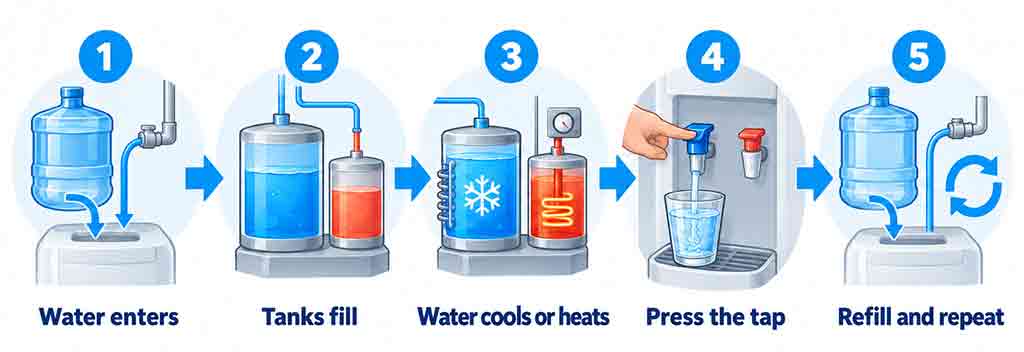
The steps of how a water cooler works are simple: Every cooler or dispenser follows the same path, whatever the brand:
- Water comes in, either from a bottle or from a water line.
- It fills a cold tank, and in hot-and-cold models, a second, smaller tank.
- The cold tank is chilled. The small tank is warmed by a heating element, and a thermostat keeps it at its set temperature.
- When you press a tap, water leaves the tank that tap is connected to.
- The tank refills from the supply, and the cycle repeats.
How Water Gets Into a Bottled vs. Bottleless Water Cooler
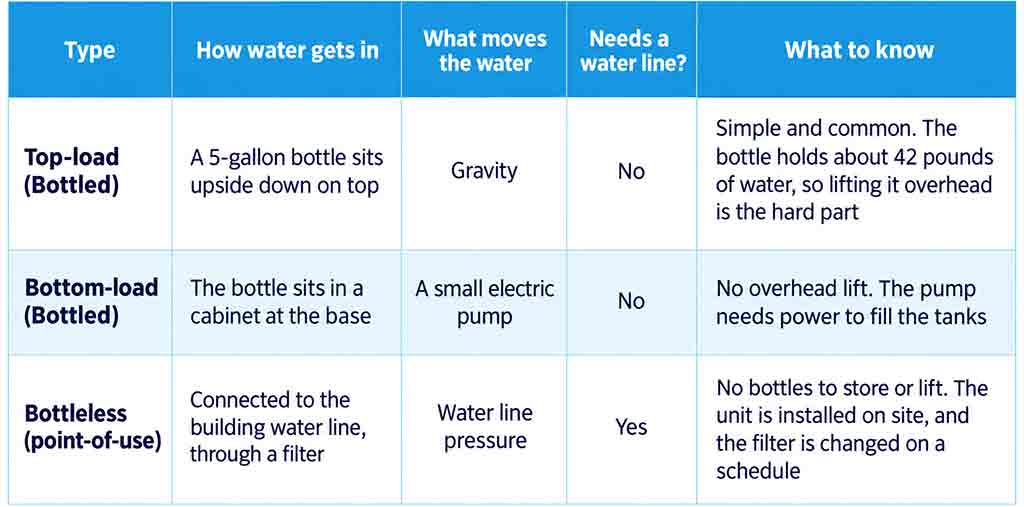
A hot and cold water dispenser gets its water in one of 3 ways:
Top-Load Bottled Coolers
On a top-load cooler, you turn a water bottle upside down and set it on the top. A short probe opens the bottle, and the water flows down into the cold tank because of gravity. As water leaves the bottle, air slips in to take its place, which is the bubble you see. You need to get 5-gallon jugs that are made to fit most standard top-load floor-standing water cooler models.
Bottom-Load Bottled Coolers
A bottom-load cooler keeps the bottle in a cabinet at the base, so there is no overhead lift. A tube runs from the bottle’s cap to the bottom of the bottle, and a small pump lifts the water up to the tanks. That pump needs power, so after you put in a new bottle, you may hear it run for a few minutes while the tanks fill.
Bottleless (Point-of-Use) Coolers
A non-filtered or filtered bottleless cooler connects to a cold water line, which the ENERGY STAR water cooler specification calls a pressurized water source (ENERGY STAR specification). It runs the water through filters before it reaches the tanks. Both floor coolers and our water counter-top coolers work this way, and our team sets them up. Cooler and bottle sizes vary by model, so the office water cooler size is worth checking before you choose.
How does a Water Cooler Make Water Cold?
A cooler chills its cold tank in one of two ways, and in both the heat does not vanish. It moves out into the room. Most coolers hold cold water at about 40°F to 50°F.
Compressor Cooling (the Same Idea as a Refrigerator)
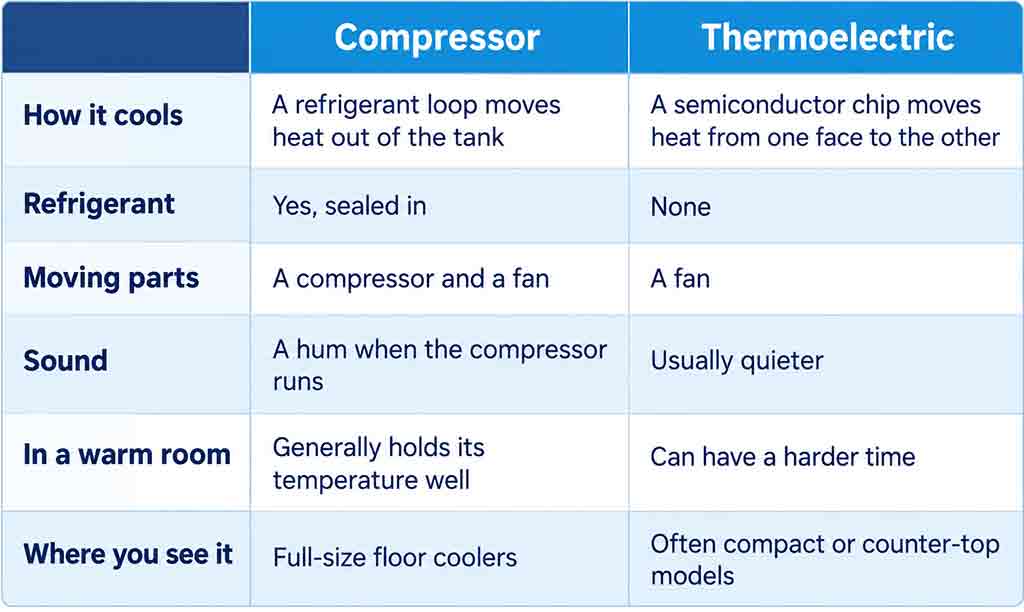
Most full-size coolers chill water the way a refrigerator does. The loop has 4 steps:
- A compressor squeezes a refrigerant gas, which makes it hot.
- The hot gas travels through coils, usually at the back, and gives its heat to the room. As it cools, it turns to liquid.
- The liquid passes through a very narrow tube, where the pressure drops and it turns cold.
- Coils wrapped around the cold tank, called the evaporator, take heat out of the water. The refrigerant then goes back to the compressor, and the loop starts again.
The heat is not destroyed. It moves from the water into the room, which is why the back of a working cooler feels warm. The refrigerant is sealed in, and only a certified technician should service it (EPA).
Thermoelectric Cooling (the Peltier Effect)
Smaller counter-top coolers often use a thermoelectric chip instead. It is a flat chip made of semiconductor material (US Department of Energy). When electricity passes through it, one face turns cold, and the other turns hot, which is called the Peltier effect. The cold face touches the tank. The hot face is attached to a metal heat sink, and a small fan blows the heat away. There is no refrigerant and no compressor, so these units tend to be quiet, but they can have a harder time in a warm room.
How does a Water Cooler Heat Water?
A hot-and-cold cooler has a second, smaller tank with an electric heating element, a little like a tiny water heater. A thermostat turns the element on and off to hold the water at its set temperature. That temperature is high, often between about 165°F and 200°F depending on the model, but it stays below boiling, which is 212°F at sea level. Because the tank is small, heavy use pulls in cooler water that needs time to reheat. A cold-only cooler skips this tank, so it has no hot tap.
Why Hot and Cold Water Stay Separate
The cold tank and the hot tank are separate, and each tap draws from its own tank. That is why one cooler can give you both a cold glass and a hot cup, and why the two do not mix at the tap. Both tanks refill from the same supply.
Hot Water Safety
The hot tap on a cooler runs hotter than the water from a home faucet, which is best kept at or below 120°F. Water at 140°F can cause a serious burn in a few seconds, and water at 160°F can do it in about one second (UTMB Department of Pediatrics). For that reason, many hot-and-cold coolers have a child safety lock on the hot tap, though not every model has one. Check that yours has a lock, keep it on, and place the cooler where young children cannot reach the taps.
The Main Parts Inside a Water Cooler and What They Do
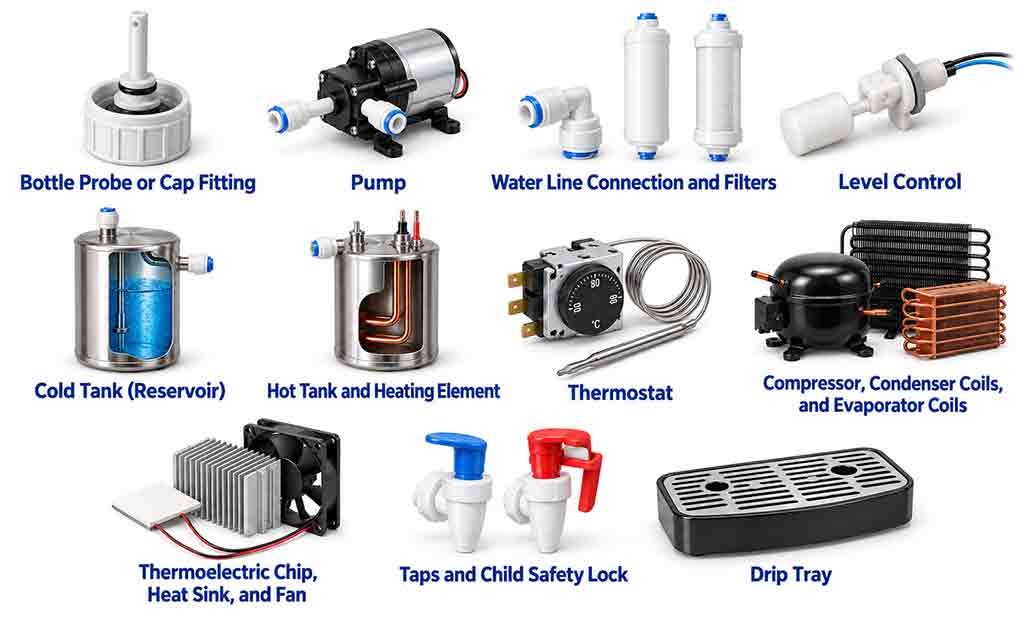
The parts inside a water cooler include:
- Bottle Probe or Cap Fitting: Opens the bottle and lets water flow out. Found in top-load and bottom-load coolers.
- Pump: Lifts water from a lower cabinet up to the tanks. Found in bottom-load coolers.
- Water Line Connection and Filters: Bring in building water, catch sediment, and reduce chlorine taste and odor. Found in bottleless coolers.
- Level Control: Tells the pump or the water line when to stop filling. Found in most coolers.
- Cold Tank (Reservoir): Holds the chilled water. This is the tank worth keeping clean, so clean your water cooler regularly. Found in all coolers.
- Hot Tank and Heating Element: A small separate tank that warms and holds the hot water. Found in hot-and-cold coolers.
- Thermostat: Turns cooling or heating on and off to hold the set temperature. Found in all electric coolers.
- Compressor, Condenser Coils, and Evaporator Coils: The refrigeration loop that chills the cold tank. Found in compressor models.
- Thermoelectric Chip, Heat Sink, and Fan: The chip chills the tank, and the other parts carry the heat away. Found in thermoelectric models.
- Taps and Child Safety Lock: Release the water, and the lock stops the hot tap from opening by accident. Found in all coolers, though not every model has a lock, so check yours.
- Drip Tray: Catches spills. Found in all coolers.
What You Hear, See, and Feel While a Water Cooler Runs
A running cooler makes a few sounds and changes that are normal.
- Bubbles in the Bottle: When you fill a glass, you may see a bubble rise through a top-load bottle. That is air moving in to replace the water that left.
- A Low Hum That Starts and Stops: The thermostat is turning the compressor on and off to hold the temperature.
- A Warm Back Panel: The heat from the cooling loop leaves through the back, so give the cooler some space from the wall and follow the manual.
- A Wait After Unplugging: Many manuals ask you to wait a few minutes before plugging the cooler back in, so the refrigerant can settle.
- Pump Noise After a Bottle Change: On a bottom-load cooler, the pump runs for a few minutes while the tanks fill.
- Slow Cooling or Leaks: These are not normal. If your cooler does either, it may be time to think about a water cooler upgrade.
How Much Power Does a Water Cooler Use?
Energy use depends on the cooler. ENERGY STAR certified water coolers use about 22 percent less energy than standard models,, and cold-only units have a limit of 0.16 kilowatt-hours a day when no water is drawn. A hot tank has to stay hot, so a hot-and-cold cooler uses more power than a cold-only one. Check your cooler’s manual for its outlet and power needs.
Get Your Home or Office Water Cooler Delivered
How does a water cooler work? It stores water in one or two tanks, chills one with a refrigeration system or a thermoelectric chip, and heats the other with an electric element.
The quality of the cooler matters because it affects how cold the water gets, how it tastes, and how long the unit runs without trouble. That is why every Inland Springs cooler comes with regular maintenance and basic troubleshooting included in the monthly fee.
At Inland Springs Water Pros, we rent 3 types of water coolers for a monthly fee: a floor-standing spring water cooler with hot and cold taps, a filtered water floor cooler, and a filtered water counter-top cooler. Both filtered models use multi-stage filtration that catches sediment and reduces chlorine taste and odor, and our team sets them up for you.
We deliver to homes and offices in Gainesville, Murrayville, Buford, Cumming, Flowery Branch, and Dawsonville.
To get a cooler delivered, visit our Get Pricing page or call 770-534-7873, Monday to Friday, 8 AM to 5 PM.
Frequently Asked Questions
How does a water dispenser work?
A water dispenser works the same way as a water cooler. Water comes in from a bottle or a water line and fills a cold tank and, in some models, a small hot tank. The cold tank is chilled, the hot tank is heated, and each tap draws from its own tank.
How long does it take for a water cooler to cool water?
The first cool-down usually takes 1 to 3 hours, or longer in a warm room. After that, the cooler just tops up the cold tank.
How does a water cooler keep water cold?
A compressor loop or a thermoelectric chip pulls heat out of the cold tank and sends it into the room. That is why the back of a working cooler feels warm.
Why does my water cooler bubble/gurgle?
Air enters the bottle to replace the water that left. The bubble is normal on a bottled cooler and means the water is flowing out as it should.
Do bottleless water coolers need plumbing?
Yes. A bottleless cooler connects to a cold water line and needs a nearby electrical outlet. Inland Springs sets up its filtered water floor cooler and counter-top models for you.
Does a water cooler use a lot of electricity?
It depends on the model. A hot tank has to stay hot, so hot-and-cold coolers use more power than cold-only ones.