
Reverse Osmosis vs Spring Water: Which Is Better?

Worried your home RO filter might fail without you noticing, or that bottled water costs too much? When comparing reverse osmosis vs spring water, the key differences are treatment, natural minerals, taste, cost, and convenience.
Reverse osmosis (RO) uses a membrane to reduce dissolved substances, while spring water comes from an underground source and usually contains natural minerals. Both can be safe for drinking. The better choice depends on your water quality, budget, and household needs.
What Are the Key Differences Between Reverse Osmosis and Spring Water?
The main difference is in the approach to everyday drinking water. Reverse osmosis uses a filtration system to treat water at home, while the spring water jugs come from a natural underground source and can be purchased in bottles or delivered.
The table below compares a typical under-sink RO system with spring bottled water:
| Feature | Reverse Osmosis (RO) | Spring Water |
| Origin | Tap or well water treated at home | Underground spring source |
| Treatment | RO membrane and filtration stages | Varies by producer |
| Minerals | Mostly reduced unless added back | Naturally occurring; varies by source |
| pH Level | Varies; may be mildly acidic | Varies; may be neutral or alkaline |
| Taste | Often mild or neutral | Mineral content affects flavor |
| Safety | Depends on system performance and maintenance | Depends on source quality and bottling standards |
| Convenience | On-demand through a dedicated faucet | Bottles or delivered jugs |
| Maintenance | Filter and membrane replacement | Jug handling and dispenser cleaning |
| Cost | Upfront equipment and ongoing expenses | Recurring water and delivery costs |
| Environmental Impact | Reject water and used filters | Packaging, cleaning, and transportation |
Water Origin
Reverse osmosis (RO) water usually comes from municipal tap water or a private well. At home, an RO system connects to the water supply and treats it before it reaches a dedicated drinking-water faucet. RO describes how the water is treated, not where it originally comes from.
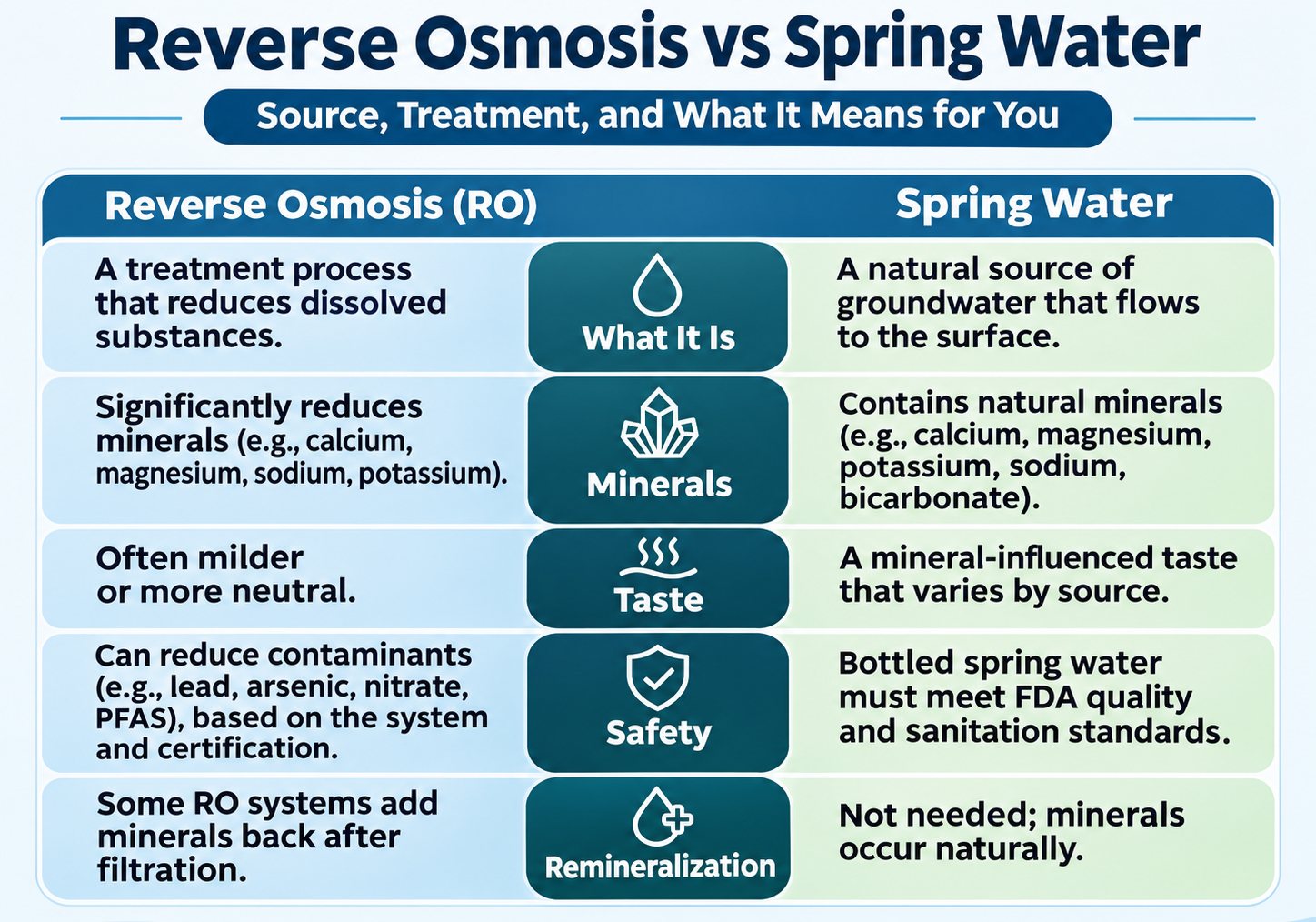
Spring water comes from an underground formation where water naturally flows to the surface. As it passes through rock and soil, it picks up minerals such as calcium and magnesium. Under FDA rules, spring water must be collected at the spring or through a borehole tapping the formation that feeds it. (FDA)
Treatment: How They’re Processed
Reverse osmosis uses pressure to push water through a semipermeable membrane, a thin barrier that lets water pass while reducing dissolved substances.
Home RO systems often use several treatment stages:
- Sediment filters remove dirt, rust, and other particles.
- Carbon filters reduce certain chemicals, tastes, and odors.
- The RO membrane reduces dissolved minerals and selected contaminants.
- Postfilters provide additional treatment before drinking.
The process produces treated drinking water and a separate stream of rejected water. On the other hand, commercially bottled spring water may undergo filtration, ultraviolet treatment, ozonation, or other permitted processes. Treatment varies by producer, and bottled water must meet applicable quality and sanitation standards.
Mineral Content
Spring water generally contains more natural minerals than standard RO water. Common minerals include:
- Calcium
- Magnesium
- Potassium
- Sodium
- Bicarbonate
Mineral levels vary by source. Reverse osmosis reduces most dissolved minerals, including calcium and magnesium. Some RO systems add selected minerals back through a remineralization cartridge.
Both provide hydration, and higher mineral levels do not automatically mean better health. Food also supplies essential minerals.
pH Level
Spring water is not always more alkaline than RO water. Both have varying pH levels, which measure how acidic or alkaline water is. A pH of 7 is neutral, below 7 is acidic, and above 7 is alkaline.
Spring-water pH depends on its source and minerals. RO water may become mildly acidic as it absorbs carbon dioxide, while remineralization can change its pH. Neither higher nor lower pH automatically provides health benefits.
Reverse Osmosis vs Spring Water Cost
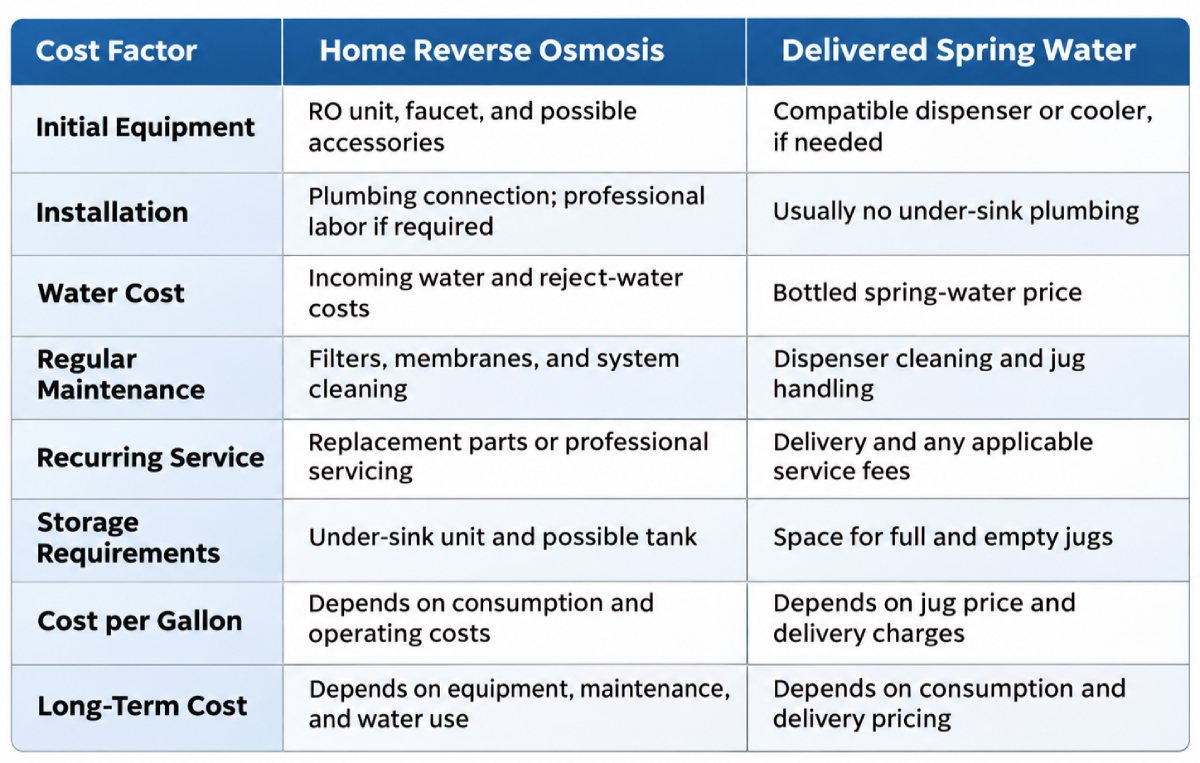
A home reverse osmosis system may cost less per gallon over time than delivered spring water, but the actual cost depends on household consumption and ongoing expenses.
RO costs include:
- Equipment and possible installation.
- Replacement filters and membranes.
- Water used during treatment.
- Repairs or professional servicing when needed.
Spring-water delivery involves recurring water charges, possible delivery fees, and any applicable dispenser or bottle costs.
A household using 20 gallons monthly would need four 5-gallon jugs, or 48 jugs annually.
Comparing actual annual expenses, including RO installation and recurring delivery charges, shows which option costs less.
Taste
Neither spring water nor RO water tastes better to everyone. Spring water gets its flavor partly from natural minerals such as calcium and magnesium. RO water often tastes milder or more neutral because it contains fewer dissolved minerals.
Carbon filtration can reduce unwanted tastes and odors, while remineralization may change RO water’s flavor. But remember that taste alone cannot confirm water safety.
For a broader comparison, our blog about spring water vs. filtered water explains how source and treatment affect drinking water.
Safety
Neither RO water nor commercially bottled spring water is automatically safer. Safety depends on source quality, treatment, and proper handling.
A suitable RO system can reduce lead, arsenic, nitrate, and certain PFAS, depending on its certified capabilities. NSF/ANSI 58 sets standards for RO systems, but each model’s specific contaminant-reduction claims must be checked. (NSF)
Commercially bottled spring water must meet applicable FDA quality and sanitation standards.
A low total dissolved solids (TDS) reading does not prove water is safe. TDS measures dissolved substances, not individual contaminants.
Convenience
An under-sink RO system provides drinking water through a dedicated faucet. It connects to household plumbing, takes up cabinet space, and may include a storage tank.
Spring-water delivery requires no under-sink RO installation. Water arrives in bottles or large jugs for use with compatible dispensers.
A 5-gallon jug can serve a home or office, but full and empty bottles need storage space and regular replacement.
The choice depends on whether you prefer an installed system or delivered drinking water.
Maintenance
RO systems need regular filter and membrane replacements. The schedule depends on the model, incoming water quality, and usage. Storage tanks, pumps, and other components may also need maintenance. Regular water cooler maintenance helps keep the reservoir and dispensing parts clean.
Spring-water delivery requires clean bottle storage, jug exchanges, and dispenser care. Suppliers handle reusable bottle cleaning, while customers maintain their dispensers.
Environmental Impact
Neither option always creates less environmental waste. RO maintenance and wastewater contribute to its environmental impact, while bottled spring water involves packaging and transportation.
Typical point-of-use RO systems can discharge five or more gallons of reject water per gallon of treated water. WaterSense-labeled systems must limit that amount to 2.3 gallons or less. Used filters and membranes also create waste. (EPA)
Single-use spring-water bottles create packaging waste. Reusable jugs reduce disposable packaging but still require washing, refilling, and delivery.
The overall impact depends on RO efficiency, container reuse, and transportation.
Which Is Better for Your Home: Reverse Osmosis vs Spring Water Delivery?
The better choice depends on how you want to access drinking water and what your household needs. Reverse osmosis provides water through an installed treatment system, while spring-water delivery supplies bottled water without that installation.
Reverse Osmosis May Be a Better Fit When:
- You want treated drinking water directly from a kitchen faucet without storing large jugs.
- Your water contains a verified contaminant that a properly certified RO system can reduce.
- Your home has space for the equipment and plumbing connections.
- You are comfortable replacing filters and maintaining the system.
- Your actual consumption and long-term cost estimates favor an installed RO system.
Spring Water Delivery May Be a Better Fit When:
- You prefer bottled spring water with naturally occurring minerals.
- You cannot or do not want to install an under-sink filtration system.
- You would rather replace reusable jugs than maintain RO filters and membranes.
- You have space for a compatible water cooler and replacement bottles.
- Regular delivery fits your household consumption and budget.
Spring Water Delivery in Gainesville, GA
At Inland Springs Water Pros, we deliver natural spring water in reusable 5-gallon jugs to homes and offices in Gainesville, Murrayville, and nearby North Georgia communities.
Each reusable jug is cleaned and sanitized before refilling. Our delivery service provides a convenient alternative for households that prefer bottled spring water without installing a home RO system.
You can explore our natural spring water in 5-gallon jugs or call 770-534-7873 to schedule your water delivery. You can also contact Inland Springs Water Pros to ask about delivery availability and request a quote.
Conclusion
The main difference between reverse osmosis vs spring water is that RO removes many dissolved substances through filtration, while spring water retains naturally occurring minerals. Both can be safe for drinking.
North Georgia homeowners should check their water quality before choosing. Municipal-water users can review local water reports, while private-well owners should test their water to identify treatment needs. Our spring-water delivery is another option for households in Gainesville, Murrayville, and nearby areas, but it does not replace the need to address unsafe well water used elsewhere in the home.
Frequently Asked Questions
Is RO Water Hard on the Kidneys?
No, properly treated RO water is not known to harm healthy kidneys. People with kidney disease should follow their doctor’s drinking-water and dietary advice.
Is RO Water Safer Than Spring Water?
Not necessarily. Both can be safe for drinking. RO safety depends on system performance and maintenance, while bottled spring water must meet quality standards.
Is Spring Water Reverse Osmosis?
No, spring water is defined by its underground source, while reverse osmosis is a treatment process. Some bottled water undergoes RO treatment.
Is Reverse Osmosis Water Better Than Spring Water?
Neither is always better. RO reduces dissolved substances, while spring water retains natural minerals. The better choice depends on water quality, cost, and taste.
Is Spring Water Healthier Than Reverse Osmosis Water?
Not necessarily. Both provide hydration. Spring water contains natural minerals, but their presence does not automatically make it healthier than properly treated RO water.
Does Reverse Osmosis Water Taste Different From Spring Water?
Yes, RO water often tastes milder or more neutral because it contains fewer dissolved minerals. Spring water has a mineral-influenced flavor that varies by source.
Does Reverse Osmosis Remove All Minerals?
No, RO substantially reduces calcium, magnesium, sodium, potassium, and other dissolved minerals, but removal is not always complete. Some systems add minerals back afterward.
Does Reverse Osmosis Remove All Contaminants?
No, RO systems can reduce contaminants such as lead, arsenic, and certain PFAS, but removal depends on the system’s specific certified capabilities and maintenance.
Is RO Water the Same as Distilled Water?
No, reverse osmosis uses membrane filtration, while distillation involves evaporation and condensation. Both processes can reduce dissolved minerals, but they work differently.
Is a Reverse Osmosis System Worth It?
An RO system can be worthwhile when its verified treatment capabilities meet your needs and its installation, maintenance, and operating costs fit your budget.
