Artesian Water vs Spring Water: What Is the Difference?

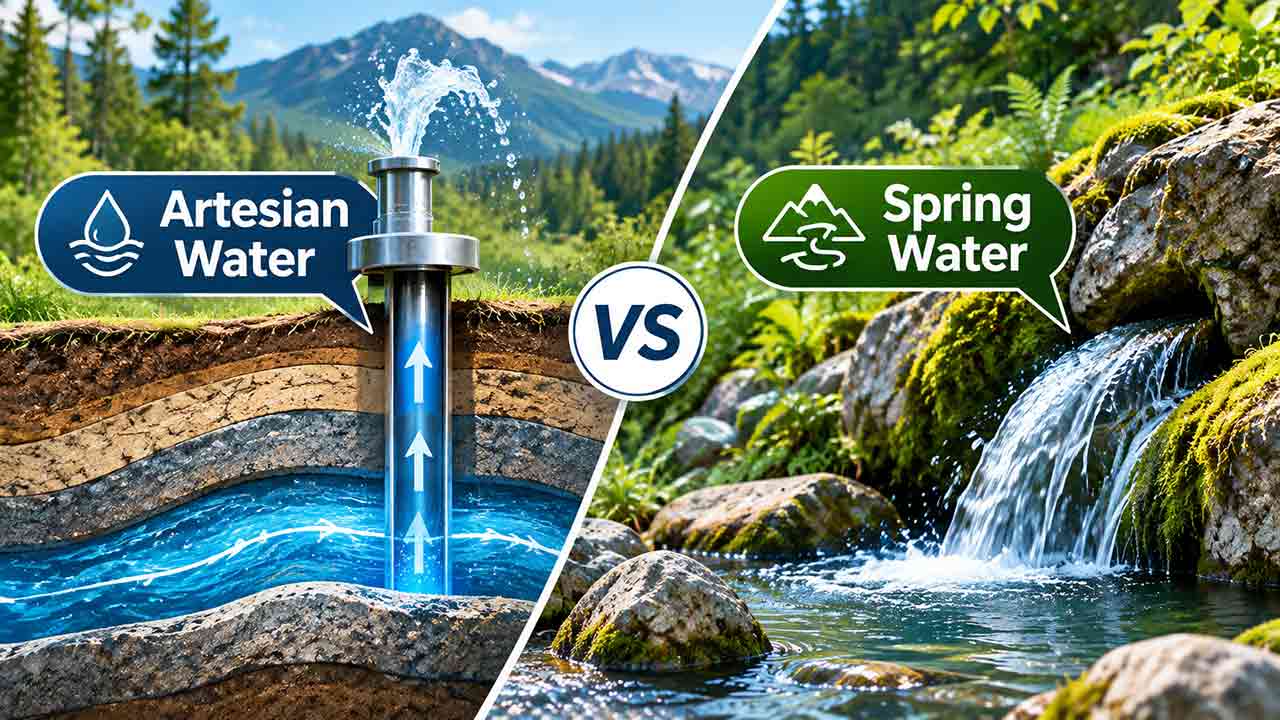
The difference between artesian water vs spring water comes down to how the water reaches the surface. Spring water flows naturally from an underground formation, or is collected through a borehole into that formation. Artesian water comes from a confined aquifer, where pressure pushes it up a well, often without a mechanical pump.
This guide explains the difference and how to choose between them.
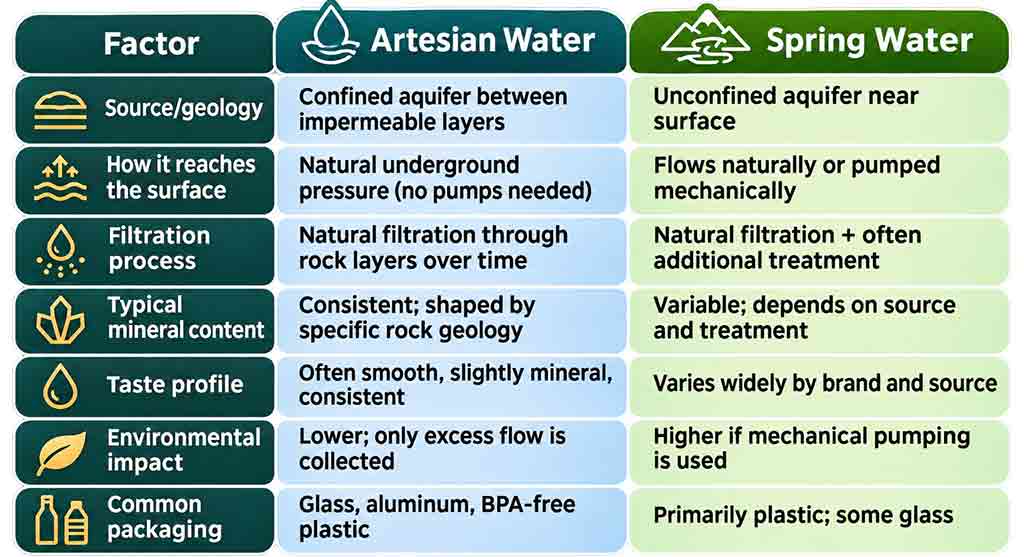
What Is Artesian Water vs Spring Water?
Artesian and spring water are groundwater sold as bottled water. Each word describes where the water comes from and how it is collected. The FDA defines each one.
What Is Spring Water?
The FDA says spring water flows naturally to the surface through a natural opening. It can be collected at the spring or through a borehole into the formation that feeds it. If a pump is used, the borehole must tap the same underground layer, and a test must show the borehole and the spring are connected.
The definition covers how the water is collected, not what happens before bottling. Pumping is allowed under the borehole rules, and bottlers of all types typically use ozone gas (FDA consumer update).
What Is Artesian Water?
The FDA defines artesian water as water from a well that taps a confined aquifer, where the water level stands above the top of the aquifer (FDA regulation). A confined aquifer is a water-holding layer of sand, gravel, or rock that sits between layers water cannot easily pass through (USGS).
Pressure is key. Because the water is trapped, pressure pushes it up the well on its own. If the pressure is strong, the water reaches the surface without a pump. If it rises but stays below the ground, it is still artesian when the water level stands above the top of the aquifer.
So artesian describes the conditions that make water rise, not a place.
What are the Artesian Water vs Spring Water Differences?
The two differ in 4 ways: how the water reaches the surface, safety, protection from contamination, taste, and shelf life. Each one is covered below.
Reaching the Surface
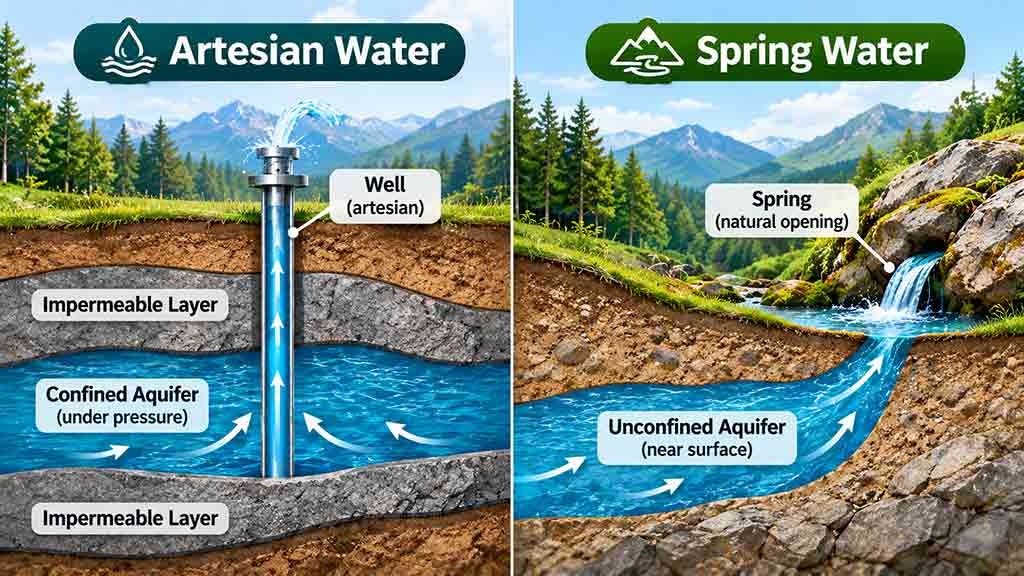
As we mentioned, a natural spring flows out of the ground on its own. A flowing artesian well pushes water above the ground at the wellhead. A non-flowing artesian well lets water rise but stay below the surface, so a pump may lift it the rest of the way. This is why “no pump” is not the test for either label.
So is artesian water the same as spring water? No, but one source can meet both sets of rules. That is why you may see “artesian spring water” on a label. A flowing artesian well water is not automatically spring water, because spring water needs natural flow through a natural opening and a named location.
Safety and Purity
Neither label means the water is safer or purer. Both are source labels. A confined aquifer has a layer above it that lowers exposure to surface runoff. A spring can be just as well protected, depending on its setting and how it is tested. Neither point proves quality.
Groundwater from any aquifer can carry natural minerals or contaminants, which is why EPA advises private well owners to test their water. Neither label makes a health claim, so choosing between them is about taste and convenience.
Taste, pH, and Alkalinity
Taste depends on the minerals dissolved in the water, which come from the rock it passes through. The amount of dissolved minerals is called total dissolved solids (TDS). Both artesian and spring water cover a wide range, so the label cannot tell you how a bottle will taste.
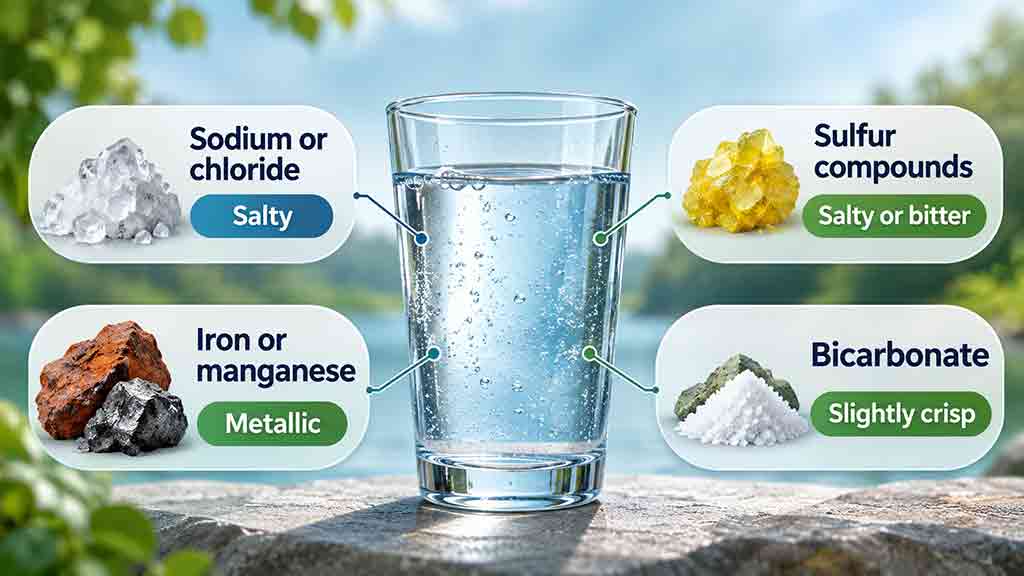
Certain minerals change taste:
- Sodium or chloride can taste salty.
- Sulfur compounds can taste salty or bitter.
- Iron or manganese can taste metallic.
pH shows how acidic or alkaline water is, and a reading above 7 is alkaline. Neither definition requires alkaline water, and pH varies within both types. Both numbers appear on a product’s lab report or label, so ask for them if a company calls its water alkaline.
| Number | What it means |
| 250 ppm TDS | The minimum for water labeled mineral water under FDA rules. No minerals may be added. |
| Below 500 ppm or above 1,500 ppm | Mineral water labels must then say “low mineral content” or “high mineral content”. |
| 500 mg/L TDS | A non-enforceable guideline tied to taste, odor, and color, not health. |
| pH 6.5 to 8.5 | The non-enforceable range for drinking water. |
| Under 50 ppm TDS | Very flat, almost no mineral character |
| 50–150 ppm TDS | Light and clean, subtle mineral finish |
| 150–300 ppm TDS | Medium body, more pronounced minerality |
| 300+ ppm TDS | Distinctly mineral, sometimes described as “hard” |
The 50–150 ppm range is often described as the most drinkable for everyday hydration. The specific minerals in that range matter too. Calcium and magnesium tend to read as “smooth,” while sodium reads as “soft” and bicarbonate adds a slight crispness.
Sustainability
Unopened bottled water does not go bad on a set date. The FDA does not require an expiration date, and the “sell by” date, often about two years after bottling, is not a safety cutoff. Store bottles in a cool, dry place, out of direct sunlight, and away from cleaners, fuels, and solvents, because plastic can pick up odors.
Most bottled water, whatever the source, comes in single-use plastic. Glass and aluminum can be recycled many times, and aluminum has a well-established recycling system in the US.
How Do You Read a Bottled Water Label?
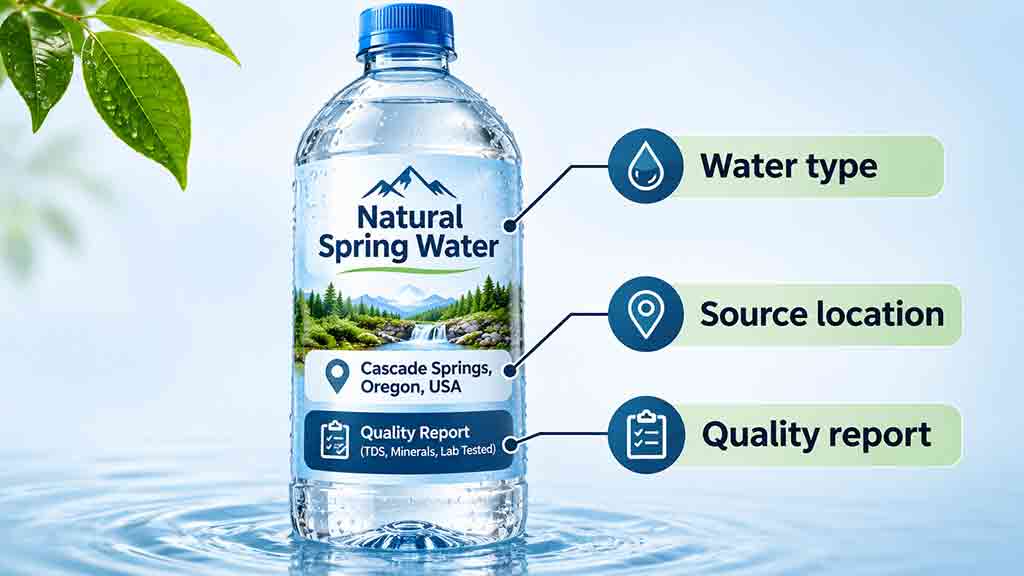
Check three things on a bottle or a delivery company’s website: the water type in plain words, a named source location (required for spring water), and a link to a recent quality report. If one is missing, ask the company.
| Label term | What it tells you | What it does not tell you |
| Artesian water | Source is a confined aquifer | Purity, mineral level, or pH |
| Spring water | Source is a named spring | Mineral level, pH, or test results |
| Mineral water | At least 250 ppm TDS, no added minerals | Whether the source is artesian or a spring |
| Purified water | Treated by distillation, reverse osmosis, or a similar process | The original source |
| Well water | Source is a drilled or bored well | Whether the aquifer is confined |