
Is Gainesville Water Safe to Drink? 2025 Water Quality Report

You might have heard that some people in another state had water poisoning, so you ask yourself: Is Gainesville water safe to drink? Yes, Gainesville tap water is safe to drink based on the City’s latest available 2025 Water Quality Report. The City reports that its drinking water met state and federal standards. However, household plumbing, seasonal changes in Lake Lanier, and individual water sources can affect what comes out of a particular tap.
Table of Contents
ToggleWhere Does Gainesville, GA Get Its Drinking Water?
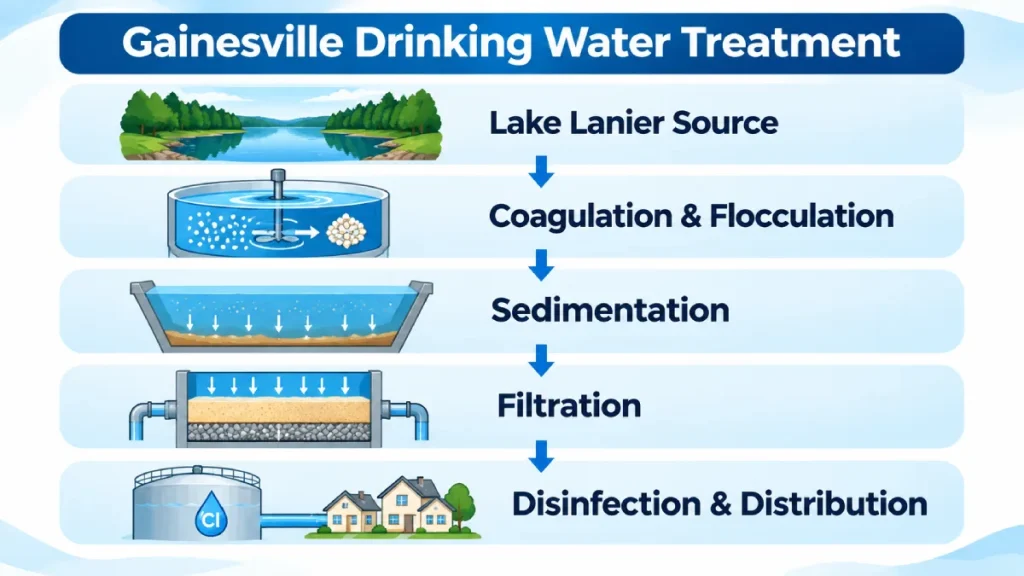
Gainesville, Georgia gets its public drinking water from Lake Lanier. The City of Gainesville Water Resources treats this surface water at two facilities before sending it through the distribution system to homes and businesses.
The two treatment facilities are:
- Riverside Water Treatment Plant
- Lakeside Water Treatment Plant
Surface water comes from lakes, rivers, and reservoirs. It can contain natural materials, sediment, and microorganisms. Treatment removes or reduces these substances before the water enters public pipes.
The City identifies its public water system as GA1390001. Its service area extends beyond Gainesville city limits, so not every home in Hall County necessarily receives water from this system.
Is Gainesville Tap Water Safe to Drink? 2026 Water Quality Report
Gainesville tap water meets federal drinking water standards, according to the City’s latest report. The 2026 Water Quality Report has not yet been released. The latest available report covers January 1 to December 31, 2025, and confirms that the system met applicable standards.
Selected results from the Gainesville Water Quality Report in 2025:
Substance | City-reported result | EPA limit / standard | How to read it |
Chlorine | 1.41 ppm; range 0.0 to 2.20 ppm | 4.0 ppm MRDL | Disinfectant used to control microbes. |
Chlorite | 0.083 ppm; range 0.02 to 0.38 ppm | 1.0 ppm MCL | Disinfection byproduct. |
HAA5 | 18.4 ppb; range 15.5 to 20.1 ppb | 60 ppb MCL | Highest locational running annual average. |
TTHM | 26.53 ppb; range 20.7 to 29.1 ppb | 80 ppb MCL | Disinfection byproduct; highest locational running annual average. |
Nitrate/nitrite | 0.4245 ppm; range 0.292 to 0.557 ppm | 10 ppm MCL | Measured together in the City report. |
Turbidity | Highest value 0.30 NTU | 1.0 NTU limit; 100% of samples below 0.5 NTU | Measures water clarity. |
Total coliform | Average 0.14%; range 0 to 1.66% | No more than 5% of monthly samples positive | The system met the applicable standard. |
Lead | 0.34 ppb; range 0.0 to 3.8 ppb; zero sites above action level | 10 ppb action level | Home tap samples collected in Fall 2024. |
The City reports that all listed results met EPA standards. A detected substance does not automatically indicate a violation.
Two terms explain the limits in the table:
- MCL: Maximum Contaminant Level, the enforceable limit for a contaminant in drinking water.
- MRDL: Maximum Residual Disinfectant Level, the highest permitted level of a disinfectant in treated water.
The lead action level is a separate regulatory threshold based on tap-water sampling. Zero tested sites above this level does not mean every home is lead-free. Read the full City of Gainesville 2025 Water Quality Report.
Is Gainesville Rainwater Safe to Drink?
Collected rainwater is not automatically safe to drink. It can pick up bacteria, chemicals, and debris from the air, roof, gutters, and storage tank.
If you collect rainwater for drinking:
- Install a first-flush diverter to remove initial roof runoff.
- Keep storage tanks covered and screened.
- Clean gutters and tanks regularly.
- Test for bacteria and chemicals on a regular schedule.
- Choose treatment based on test results.
- Keep rainwater pipes separate from treated water pipes.
Boiling kills many germs but does not remove chemicals or metals. A basic pitcher filter may not remove all contaminants.
Is Gainesville Well Water Safe to Drink?
Private well water in Gainesville and Hall County can be safe to drink if the well is properly built, maintained, and tested. Its safety cannot be determined by taste, smell, or appearance.
Private well owners are responsible for testing their water. The Georgia Department of Public Health recommends:
- Annual total coliform and fecal coliform testing.
- A W33C chemical screen every three years, including arsenic and lead.
Test your well after flooding, repairs, or noticeable changes in water quality. Keep fertilizers, fuel, chemicals, and surface runoff away from the wellhead.
For local well-water testing, contact UGA Hall County Extension:
- Address: 734 E. Crescent Drive, Suite 300, Gainesville, GA 30501
- Phone: (770) 535-8293
The Hall County Extension office offers water testing. Confirm which testing panel you need before submitting a sample.
Why Does Gainesville Water Taste Earthy or Smell Musty?
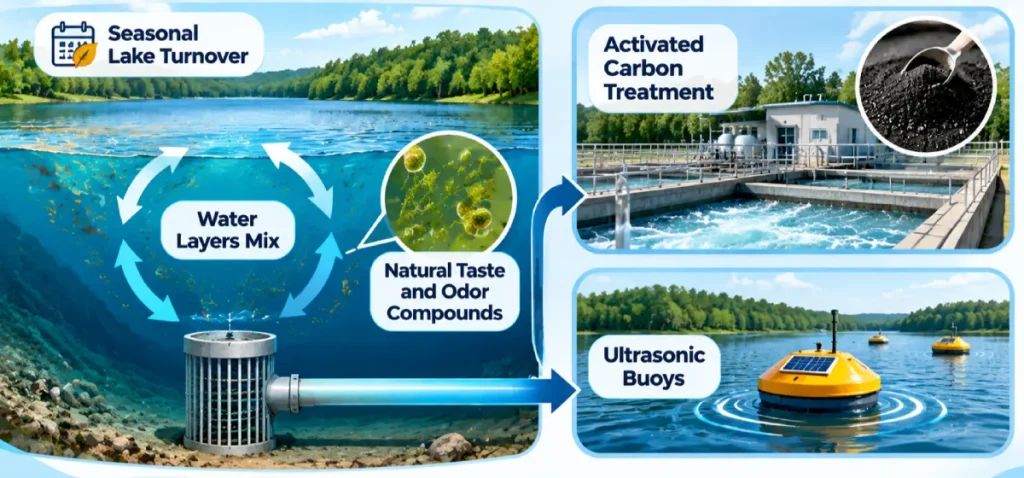
Gainesville water can develop an earthy or musty taste during seasonal Lake Lanier turnover, when temperature changes mix different layers of lake water and move naturally occurring taste-and-odor compounds into the water supply.
During the second half of 2025, the City reported an unusually strong and prolonged taste-and-odor issue. It classified the problem as aesthetic, not a health concern.
To address it, the City:
- Added powdered activated carbon at both treatment plants.
- Increased filter washing and water testing.
- Adjusted treatment processes.
- Deployed three ultrasonic buoys near the Riverside intake in January 2026 to help control algae.
An earthy taste during seasonal turnover does not automatically indicate unsafe water. However, report sudden or persistent changes in taste, smell, or color to Gainesville Water Resources.
See the City of Gainesville’s Taste and Odor updates for local information.
What Do EWG and EPA Records Say About Gainesville Water?
Is Gainesville water safe to drink despite the contaminants reported by EWG? Yes. EWG uses stricter, non-enforceable health guidelines, while Gainesville’s latest report confirms compliance with federal drinking water standards.
EWG reports 11 contaminants above its health guidelines and 18 detected Gainesville tap water contaminants. However, these figures do not mean the City has 11 active EPA violations.
The difference comes from the standards and testing periods each source uses. The City’s 2025 Water Quality Report covers January to December 2025 and measures compliance with enforceable drinking water standards. EWG uses older data from 2015 to 2023, including averages from 2021 to 2023, and compares results against its own, non-enforceable health guidelines.
Why Gainesville water databases show different numbers:
Source | Data period | Reported findings |
City of Gainesville 2025 CCR | January to December 2025; revised June 2026 | Results met state and federal drinking water standards. |
EWG Tap Water Database | 2015 to 2023; many averages from 2021 to 2023 | 11 contaminants above EWG health guidelines; 18 detected. |
EPA compliance records | 2026 snapshot | One resolved Tier 3 treatment-technique record from 2024; no health-related violation in the reviewed snapshot. |
Some older EWG results include:
- TTHM: 31.7 ppb.
- HAA9: 20.3 ppb.
- Chromium-6: 0.09 ppb.
These are historical results, not measurements from the City’s 2025 report. HAA9 and HAA5 also represent different groups of disinfection byproducts, so their values should not be compared directly.
Review the EWG Tap Water Database for Gainesville’s historical contaminant data.
Is Gainesville Water Hard or Soft?
Gainesville water is soft. The City’s 2025 Water Quality Report lists average Gainesville water hardness at 21.2 mg/L, or about 1.23 grains per gallon. Water hardness comes mainly from dissolved calcium and magnesium. Higher levels can leave mineral deposits on faucets, showerheads, and appliances. Gainesville’s reported level falls within the soft-water range, not the moderately hard range.
Does Gainesville Water Have Lead?
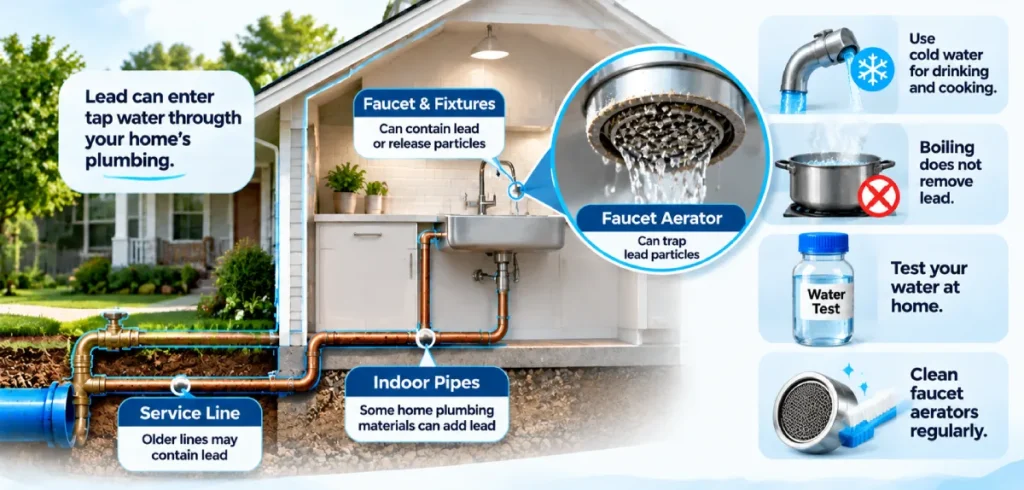
Lead can enter Gainesville tap water through household pipes, service lines, faucets, and fixtures, even when the water leaving the treatment plant contains no lead.
The City reports no known lead pipes in its utility-owned system. Its 2025 report includes home tap samples collected in Fall 2024, with zero tested sites above the reported action level. However, these results do not cover every home.
If you are concerned about lead in your water:
- Use cold water for drinking, cooking, and preparing baby formula.
- Clean faucet aerators regularly to remove collected particles.
- Ask Gainesville Water Resources about your service-line material.
- Arrange a home water test if you are unsure about your plumbing.
Boiling does not remove lead. Evaporation can actually increase its concentration.
See the EPA’s lead guidance for more information about household plumbing and lead exposure.
Does Gainesville Water Have PFAS?
Gainesville’s 2025 Water Quality Report shows that the tested PFAS were below the minimum reporting levels.
PFAS are human-made chemicals that can remain in the environment for years. The City’s report lists these results below reporting levels:
- PFOA
- PFOS
- PFHxS
- GenX
- PFAS hazard index
EPA UCMR5 records also show 29 PFAS below reporting levels in Gainesville water samples collected during 2025.
Below the reporting level does not mean zero PFAS. It means the concentrations were too low to be reliably reported by the laboratory. These results also do not represent testing at every household tap.
What Should You Do If Your Tap Water Looks, Smells, or Tastes Different?
If your Gainesville tap water changes in taste, smell, or color, check current City notices and take these steps:
- Earthy or musty taste: Check Gainesville’s seasonal taste-and-odor updates.
- Discolored water: Contact Gainesville Water Resources, especially if the change persists.
- Unusual smell: Report persistent or sudden changes to the City.
- Boil-water advisory: Follow official instructions until the advisory ends. A pitcher filter cannot replace boiling.
- Possible lead exposure: Test your tap water and consider a filter certified for lead reduction.
- Unpleasant taste: Consider a suitable drinking-water filter or bottled water based on your preferences.
Not all filters remove the same contaminants. Check the filter’s certifications before relying on it to reduce lead, PFAS, or disinfection byproducts.
Is Bottled Spring Water Safer Than Gainesville Tap Water?
Bottled spring water is not automatically safer than Gainesville tap water. Both are regulated, but their sources, treatment, and handling differ.
The EPA regulates public drinking water systems, while the FDA regulates bottled water.
Tap Water vs. Bottled Spring Water
Feature | Municipal Tap Water | Bottled Spring Water |
Regulator | EPA and state regulators | FDA |
Source | Lake Lanier surface water | Natural spring source |
Factors affecting quality | Distribution pipes and household plumbing | Source, bottling, storage, and handling |
Safety | Depends on water quality and plumbing conditions | Depends on source quality, testing, and handling |
Both options must meet applicable safety requirements. Neither guarantees better water quality in every situation.
The FDA’s bottled water guidelines cover source protection, sanitary bottling, quality controls, and testing.
Local Drinking-Water Options from Inland Springs Water Pros
At Inland Springs Water Pros, we provide water delivery services to homes and offices in Gainesville and nearby Hall County communities.
Based in Murrayville, Georgia, we offer:
- 5-gallon natural spring water in reusable bottles.
- Spring water coolers with hot and cold water options.
- Filtered water floor coolers with multi-stage filtration.
Whether you prefer delivered spring water or a bottleless cooler, we can help you choose an option that fits your home or workplace.
Contact Inland Springs Water Pros today, or call us at 770-534-7873, to ask about delivery schedules, available coolers, and current pricing in Gainesville.
FAQs
Is Gainesville tap water safe?
Yes. The City’s latest report says its public water system met state and federal drinking water standards. Individual household plumbing still matters.
Should I filter Gainesville tap water?
It depends on your concern. Choose a filter certified for the specific contaminant you want to reduce, rather than relying on taste improvement alone.
Is bottled spring water safer than tap water?
Not automatically. Both are regulated under different federal requirements. Compare documented water quality, source information, and household plumbing conditions.
How do I know if my home uses Gainesville Water Resources?
Check your utility bill for the water provider. Gainesville Water Resources uses public water system identification number GA1390001.
Does City of Gainesville water have PFAS?
The City’s 2025 report shows that the tested PFAS were below laboratory reporting levels. This does not mean the water contains zero PFAS.
How to make Gainesville city water safe to drink?
Gainesville’s municipal water already meets drinking water standards. If you suspect contamination from household plumbing, test your water and use appropriate certified filtration.
Does boiling Gainesville city water make it safe to drink?
Boiling kills many harmful germs but does not remove lead, PFAS, or other chemical contaminants. Follow official instructions during a boil-water advisory.